Why Panvel Is Maharashtra's Hottest Land Investment Destination
An operational airport, a sea bridge to South Mumbai and a planned city on its doorstep — no other Maharashtra location has this many growth drivers converging at once.
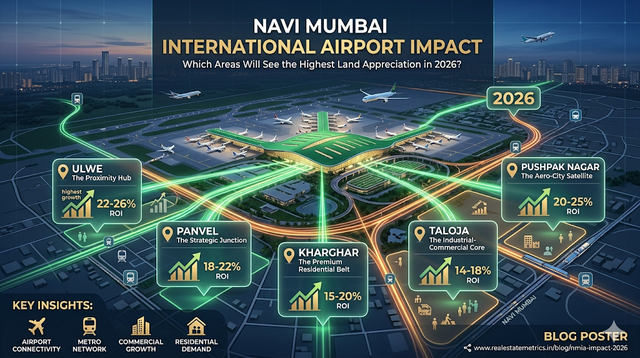
Most land markets have one growth story. Panvel has five or six running at the same time, and that convergence is what sets it apart from every other peri-urban location in Maharashtra right now.
The first and largest is Navi Mumbai International Airport. With commercial flights running since December 2025, the airport has moved from a planning document to a daily reality, and the demand it creates — for staff housing, hotels, warehousing, logistics, and services — lands disproportionately in the towns closest to it. Panvel is the closest established town.
The second is connectivity to Mumbai itself. Atal Setu (the Mumbai Trans Harbour Link) cut the drive from South Mumbai to the Navi Mumbai side dramatically when it opened in January 2024. For buyers who earlier dismissed Panvel as "too far," the travel-time math has fundamentally changed.
The third is planned urban expansion. The NAINA (Navi Mumbai Airport Influence Notified Area) framework puts a large belt of villages around Panvel under a structured development plan, with town planning schemes that allocate land for roads, amenities, and development. Planned growth is slower than speculative growth, but it tends to be more durable, because the roads and infrastructure actually follow.
The fourth is rail. Panvel is already a major junction on the suburban and long-distance network, and the Panvel–Karjat suburban corridor under construction will extend local train access further into the region. Rail connectivity has historically been one of the strongest predictors of sustained residential demand in the Mumbai region.
The fifth is road access in every direction: the Mumbai–Pune Expressway, the Mumbai–Goa highway, the JNPA port road network, and the connectors being built between Atal Setu and the expressway. Panvel sits at the junction of all of them, which is why logistics and warehousing operators have been active buyers of land in the wider area.
Finally, there's the price gap. Even after strong appreciation over the past several years, land in and around Panvel remains far cheaper per square foot than comparable connectivity in Thane or the established Navi Mumbai nodes. That gap is what draws investors who missed earlier cycles in Vashi, Kharghar, or Ulwe.
None of this means every plot with a Panvel address is a good investment. The growth drivers lift the region, but the returns on an individual plot still depend on its specific access road, title quality, zoning, and distance from the corridors that actually get built. The smart approach is to treat Panvel's macro story as the reason to look, and rigorous plot-level verification as the reason to buy — or walk away.
If you found this useful, you may also want to read Panvel vs Khopoli vs Khalapur: Where Should You Invest in 2026? and Atal Setu (MTHL) and Its Impact on Land Values in Navi Mumbai's Periphery. For a broader perspective, see Land Investment Under ₹5 Crore Near Mumbai: Best Options to Consider.
Related Articles
Plots in Panvel 2026: Why Land Near Navi Mumbai Airport Is Rising
Plots in Panvel are rising with Navi Mumbai Airport live and NAINA approvals moving. See prices, growth drivers and a checklist before you buy land.
Location GuidePlots in Khopoli: Why Buyers Are Looking Along the Expressway
Plots in Khopoli are in demand as branded developers arrive and the Missing Link opens. See price ranges, top pockets and a land-buying checklist.
Location GuidePlots in Khalapur After the Missing Link: A 2026 Land Investor’s Guide
Plots in Khalapur gain from the Missing Link, Atal Setu and the Panvel–Karjat rail line. Learn where to buy, NA vs farm land rules, and what to check.