Navi Mumbai Airport Land: What Investors Should Know Before Buying
"Near the airport" is the most overused phrase in Raigad real estate. Here's what actually matters before you buy land in NMIA's influence zone.
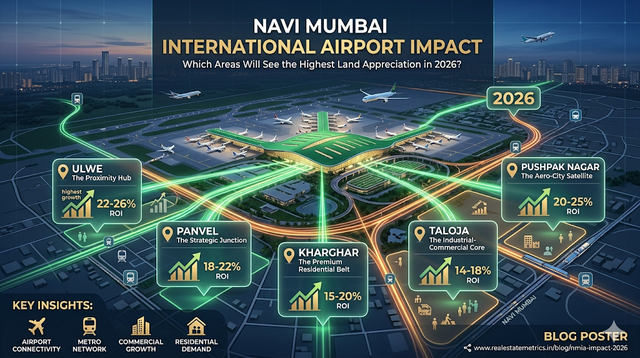
Almost every land listing within 50 km of Navi Mumbai International Airport now leads with the airport. Some of those plots will genuinely benefit from it; many are simply borrowing its name. Before you pay an airport premium, it's worth understanding what actually determines whether a plot gains from NMIA.
The first question is which planning authority governs the land. Land close to the airport generally falls under CIDCO's Navi Mumbai nodes, under the NAINA area (where CIDCO is the special planning authority), or outside both under the regular regional plan. This matters because the authority decides what can be built, how much, and through what approval process. A plot in a NAINA town planning scheme, for example, may have part of its area allocated to roads and amenities, with the owner receiving a developed final plot — so the land you own after the scheme may not be the same shape or size as the land you bought.
The second question is zoning. Proximity to an airport doesn't automatically mean residential or commercial use is allowed. Land can be zoned for agriculture, green belt, industry, logistics, or public purposes, and the zoning decides your exit options. Always get the zone confirmed from the official development plan or a zone certificate, not from the seller's brochure.
The third is aviation-related restrictions. Land around any airport is subject to building height limits set for flight safety, and the closer you are to the runway approach paths, the tighter those limits typically get. Noise exposure also affects how attractive a location is for housing. For a buyer planning a bungalow, height limits may not matter much; for one hoping to sell to a developer, they matter a lot.
The fourth is project-affected land. Large infrastructure projects in this region involved land acquisition and rehabilitation schemes, including CIDCO's 12.5% scheme for project-affected families. Plots allotted under such schemes can be legitimately bought and sold, but they come with their own transfer rules and documentation. Make sure the paperwork matches the scheme and the transfer has the required permissions.
The fifth is pricing discipline. Airport proximity has pushed asking prices up across the board, including for plots that are far from any real access road. Compare price against actual registered transactions in the same village, not against other listings, and be skeptical of any plot priced on its distance to the airport rather than its own road access and approvals.
The opportunity around NMIA is real — the airport will keep scaling for years, and the land around it will be developed in waves. The investors who do best tend to buy where infrastructure is already confirmed, with clean title and a clear zoning position, rather than paying today for promises that may take a decade to reach their specific plot.
If you found this useful, you may also want to read How to Resell Your Land: A Step-by-Step Guide for Plot Owners and How to Spot an Overpriced Plot: A Practical Pricing Framework. For a broader perspective, see Upcoming Infrastructure in Raigad District That Will Shape Land Values.
Related Articles
Farmhouse Plots Near Mumbai: Why Khalapur Works for Weekend Homes
Farmhouse plots near Mumbai: why Khalapur suits weekend homes, the rules on farm vs NA land, and the checks to make before you buy.
Investment StrategyPanvel vs Khopoli vs Karjat: Which Is Best for Land Investment in 2026?
Best place to buy land near Mumbai in 2026? Compare Panvel, Khopoli and Karjat on growth drivers, price, use and risk before you invest.
Investment StrategyNRI Guide to Buying Plots Near Mumbai: Rules, Documents and Safe Locations
NRI plots near Mumbai: what NRIs and OCIs can buy under FEMA, payment rules, power of attorney and the safest areas from Panvel to Karjat.